RxSwift Source Code Reading Part I - Observable & Observer
example("hello") {
    let disposeBag = DisposeBag()

    Observable.create { observer -> Disposable in
        observer.onNext("Hello World")
        observer.onCompleted()
        observer.onNext("Hello again")
    }
    .subscribe { event in
        print(event)
    }
    .disposed(by: disposeBag)
}
If the code above runs correctly, you will finally see the following printed in the console:
next(Hello World)
completed
In this article we’ll start from this example and explain its inner workings from RxSwift’s source code perspective.
Before We Start
- The code in this article is based on RxSwift 5.0.1.
- This article assumes you have some experience using RxSwift.
- The snippets from the source code shown here omit parts related to debugging, generics, and comments. You can find the complete source on GitHub.
Observer
An Observer is, literally, the observer, and what it observes is the Observable. We’ll talk about what an Observable is later; for now let’s focus on the Observer. The starting point of Observer is ObserverType, whose definition is as follows:
public protocol ObserverType {
    associatedtype Element

    func on(_ event: Event<Element>)
}
You can see that ObserverType has only one responsibility: respond to an Event.
Before we continue with ObserverType, let’s take a detour and look at Event.
The definition of Event itself is very simple: it’s an enum that represents next | completed | error, and it provides some APIs to conveniently extract the data in the event and to determine the event’s type.
While reading the source I noticed a detail: Event itself conforms to a protocol called EventConvertible. This protocol looks very similar to Event. Why bother defining an extra protocol? We’ll leave that for another time and skip it here.
Back to ObserverType. This type also defines methods onNext(_:), onCompleted(), and onError(_:). These are essentially just lightweight wrappers over the on(_:) method above, so we won’t go into detail.
By searching through the code, we can get a rough relationship chain around ObserverType: ObserverType -> ObserverBase -> AnonymousObserver.
Let’s first look at ObserverBase. Its own definition is also very concise:
class ObserverBase<Element> : Disposable, ObserverType {
    private let _isStopped = AtomicInt(0)

    func on(_ event: Event<Element>) {
        switch event {
        case .next:
            if load(self._isStopped) == 0 {
                self.onCore(event)
            }
        case .error, .completed:
            if fetchOr(self._isStopped, 1) == 0 {
                self.onCore(event)
            }
        }
    }

    func onCore(_ event: Event<Element>) {
        rxAbstractMethod()
    }

    func dispose() {
        fetchOr(self._isStopped, 1)
    }
}
As a base class, ObserverBase centralizes the common logic for handling Events defined by ObserverType, and at the same time provides an onCore(_:) method. The on(_:) method still forwards the event to this method. Subclasses handle events by implementing onCore(_:).
RxSwift uses this design pattern in several other places as well: provide a base class that conforms to some protocol, implement the protocol methods in the base class to hold common logic, and provide a similar method for subclasses to override. This way, when implementing subclasses you don’t have to worry about the common logic and can focus only on the specific behavior. The Producer type we’ll talk about later is another example.
From the snippet above we can see that ObserverBase uses an AtomicInt _isStopped internally to track state. So what is AtomicInt? Let’s go take a look at its definition:
final class AtomicInt: NSLock {
    fileprivate var value: Int32
    public init(_ value: Int32 = 0) {
        self.value = value
    }
}

@discardableResult
@inline(__always)
func add(_ this: AtomicInt, _ value: Int32) -> Int32 {
    this.lock()
    let oldValue = this.value
    this.value += value
    this.unlock()
    return oldValue
}

@discardableResult
@inline(__always)
func sub(_ this: AtomicInt, _ value: Int32) -> Int32 {
    this.lock()
    let oldValue = this.value
    this.value -= value
    this.unlock()
    return oldValue
}

@discardableResult
@inline(__always)
func fetchOr(_ this: AtomicInt, _ mask: Int32) -> Int32 {
    this.lock()
    let oldValue = this.value
    this.value |= mask
    this.unlock()
    return oldValue
}

@inline(__always)
func load(_ this: AtomicInt) -> Int32 {
    this.lock()
    let oldValue = this.value
    this.unlock()
    return oldValue
}
We can see that AtomicInt is essentially an NSLock that wraps an Int32 value. The provided APIs all operate on this value and use the lock to guarantee thread safety, and each of these methods returns the value before the operation.
At this point I had a question: why not just use a Bool? Why define an extra type, and why do these APIs return the old value, which looks a bit strange at first? So I checked the commit history and found that AtomicInt used to be defined differently. It used to be defined via macros in RxAtomic.h as a wrapper around stdatomic.h, implementing lock-free programming style operations for sharing data among multiple threads. RxAtomic was later split out of RxSwift, and only then was it changed to the current lock-based implementation. If you’re familiar with lock-free programming these APIs will look very familiar.
After a basic understanding of AtomicInt, let’s go back to the on(_:) method of ObserverBase:
- When a
.nextevent arrives, it first checks theisStoppedstate. If it’s 0, it continues handling the.nextevent; if it’s 1, the.nextevent will be dropped. - When an
.erroror.completedevent arrives for the first time, it setsisStoppedto 1, andfetchOrreturns the previous value 0, so it continues handling the current event. - When another
.erroror.completedevent arrives later,isStoppedis again set to 1, but this timefetchOrreturns 1, and the current event will be dropped.
From this point on, no matter what events come in, ObserverBase and its subclasses will no longer respond. This is, at an abstract level in RxSwift, why an Observable stops producing new events after a terminal event.
Now let’s turn to AnonymousObserver. After removing some debug-only logic, its definition looks like this:
final class AnonymousObserver<Element>: ObserverBase<Element> {
    typealias EventHandler = (Event<Element>) -> Void

    private let _eventHandler : EventHandler

    init(_ eventHandler: @escaping EventHandler) {
        self._eventHandler = eventHandler
    }

    override func onCore(_ event: Event<Element>) {
        return self._eventHandler(event)
    }
}
AnonymousObserver is very simple: you pass in an EventHandler when creating it, it stores it internally, and whenever a new event is observed it uses the handler to process that event.
There is another Observer type that has to be mentioned: AnyObserver. As the name suggests, AnyObserver is used for type erasure. Its definition is as follows:
public struct AnyObserver<Element> : ObserverType {
    public typealias EventHandler = (Event<Element>) -> Void

    private let observer: EventHandler

    public init(eventHandler: @escaping EventHandler) {
        self.observer = eventHandler
    }

    public init<Observer: ObserverType>(_ observer: Observer) where Observer.Element == Element {
        self.observer = observer.on
    }

    public func on(_ event: Event<Element>) {
        return self.observer(event)
    }

    public func asObserver() -> AnyObserver<Element> {
        return self
    }
}
AnyObserver can be initialized with either an EventHandler or another Observer. The implementation is straightforward, so we won’t go into more detail here. There is also an asObserver() method whose original definition is in an extension on ObserverType:
extension ObserverType {
    public func asObserver() -> AnyObserver<Element> {
        return AnyObserver(self)
    }
}
The default implementation of this method erases the concrete Observer type and returns a unified AnyObserver, while AnyObserver’s own asObserver() simply returns self.
Disposable and Cancelable
Before talking about Observable, let’s talk about Disposable and Cancelable. Their definitions are as follows:
public protocol Disposable {
    func dispose()
}

public protocol Cancelable : Disposable {
    var isDisposed: Bool { get }
}
Disposable is very simple: it only has a dispose() method, which defines how to release resources. Cancelable extends Disposable by adding a flag indicating whether it has been disposed.
We’ll come back to Disposable later; for now just have a rough idea of it.
Observable
Let’s briefly introduce Observable. Here I list all the related definitions together:
public protocol ObservableConvertibleType {
    associatedtype Element

    func asObservable() -> Observable<Element>
}

public protocol ObservableType : ObservableConvertibleType {
     func subscribe<Observer: ObserverType>(_ observer: Observer) -> Disposable where Observer.Element == Element
}

extension ObservableType {
    public func asObservable() -> Observable<Element> {
        return Observable.create { o in
            return self.subscribe(o)
        }
    }
}

public class Observable<Element> : ObservableType {
    public func subscribe<Observer: ObserverType>(_ observer: Observer) -> Disposable where Observer.Element == Element {
        rxAbstractMethod()
    }

    public func asObservable() -> Observable<Element> {
        return self
    }
}
From this we can see the relationships among these types: Observable -> ObservableType -> ObservableConvertibleType. The primary responsibility of Observable is to be subscribed to by an Observer, that is, to let an Observer receive events.
At first glance, the name of the subscribe method in ObservableType may feel counterintuitive, because your first impression is probably that an Observer subscribes to an ObservableType. Why is the interface named the other way around? When I first read the code I got stuck on this naming for a while. Eventually I gave up nitpicking and accepted that this is just a name. You could as well rename subscribe to add, and then it becomes Observable add Observer, the well-known observer pattern.
ObservableType conforms to ObservableConvertibleType and provides the default implementation of ObservableConvertibleType: it wraps the concrete ObservableType in a new Observable. This new Observable simply passes the observer to the current ObservableType’s subscribe. The implementation in Observable itself just returns self. You can see that the main role of Observable is to erase the concrete ObservableType type, and it also serves as the abstract base class for the many different concrete Observable types. Each concrete Observable implements its own subscribe(_:).
Sink
Sink literally means a sink or a basin. If we think of Observable as a stream, then Sink is the place where the stream is processed. You could say Sink is the basis on which RxSwift implements chaining operators, but that’s not the focus of this article—we’ll come back to it when we talk about operators. For now, we’ll skip those details. Let’s first look at the definition of Sink:
class Sink<Observer: ObserverType> : Disposable {
    fileprivate let _observer: Observer
    fileprivate let _cancel: Cancelable
    private let _disposed = AtomicInt(0)

    init(observer: Observer, cancel: Cancelable) {
        self._observer = observer
        self._cancel = cancel
    }

    final func forwardOn(_ event: Event<Observer.Element>) {
        if isFlagSet(self._disposed, 1) {
            return
        }
        self._observer.on(event)
    }

    final var disposed: Bool {
        return isFlagSet(self._disposed, 1)
    }

    func dispose() {
        fetchOr(self._disposed, 1)
        self._cancel.dispose()
    }
Sink itself is a Disposable. To initialize a Sink you need to provide an Observer and a Cancelable, which it holds internally. From the definition you can see that Sink is mostly a wrapper that encapsulates an Observer and a Cancelable. It doesn’t process Events itself; instead it forwards them to the internal Observer. But before forwarding, it checks whether it has been disposed; if it has, it no longer forwards events. Its dispose method simply calls dispose on the Cancelable, plus some logic to ensure it’s disposed only once. Here it again uses an AtomicInt as a flag.
Later we’ll see that not all Observer subclasses inherit from ObserverBase, so similar logic is needed elsewhere to ensure that after the first terminal event, subsequent events are no longer handled. This is exactly what Sink does.
Producer
Almost all of RxSwift’s built-in Observable subclasses do not directly inherit from Observable; instead they inherit from Producer, and Producer itself inherits from Observable. Producer is tightly coupled with Sink. Let’s look at its definition:
class Producer<Element> : Observable<Element> {
    override func subscribe<Observer: ObserverType>(_ observer: Observer) -> Disposable where Observer.Element == Element {
      // Code related to Scheduler omitted
      let disposer = SinkDisposer()
      let sinkAndSubscription = self.run(observer, cancel: disposer)
      disposer.setSinkAndSubscription(sink: sinkAndSubscription.sink, subscription: sinkAndSubscription.subscription)
      return disposer
    }

    func run<Observer: ObserverType>(_ observer: Observer, cancel: Cancelable) -> (sink: Disposable, subscription: Disposable) where Observer.Element == Element {
        rxAbstractMethod()
    }
}
From the definition we can see that Producer overrides the subscribe(_:) method and provides an additional run(_:cancel:) method for subclasses to implement. This follows the same design idea as ObserverBase: Producer, as a base class, concentrates the common logic, and provides a new method for subclasses. For now you can think of run(_:cancel:) as the subscribe(_:) method of each concrete Producer subclass.
The subscribe(_:) method of Producer introduces a SinkDisposer, so let’s go see what it does. Here’s its definition:
private final class SinkDisposer: Cancelable {
    private enum DisposeState: Int32 {
        case disposed = 1
        case sinkAndSubscriptionSet = 2
    }

    private let _state = AtomicInt(0)
    private var _sink: Disposable?
    private var _subscription: Disposable?

    var isDisposed: Bool {
        return isFlagSet(self._state, DisposeState.disposed.rawValue)
    }

    func setSinkAndSubscription(sink: Disposable, subscription: Disposable) {
        self._sink = sink
        self._subscription = subscription

        let previousState = fetchOr(self._state, DisposeState.sinkAndSubscriptionSet.rawValue)
        if (previousState & DisposeState.sinkAndSubscriptionSet.rawValue) != 0 {
            rxFatalError("Sink and subscription were already set")
        }

        if (previousState & DisposeState.disposed.rawValue) != 0 {
            sink.dispose()
            subscription.dispose()
            self._sink = nil
            self._subscription = nil
        }
    }

    func dispose() {
        let previousState = fetchOr(self._state, DisposeState.disposed.rawValue)

        if (previousState & DisposeState.disposed.rawValue) != 0 {
            return
        }

        if (previousState & DisposeState.sinkAndSubscriptionSet.rawValue) != 0 {
            guard let sink = self._sink else {
                rxFatalError("Sink not set")
            }
            guard let subscription = self._subscription else {
                rxFatalError("Subscription not set")
            }

            sink.dispose()
            subscription.dispose()

            self._sink = nil
            self._subscription = nil
        }
    }
}
SinkDisposer conforms to Cancelable and uses an AtomicInt internally to track state.
First look at its setSinkAndSubscription(sink:subscription:) method. If it’s called for the first time, previousState is 0, so neither of the two if branches is taken. sink and subscription are set normally, and _state becomes sinkAndSubscriptionSet. If you call this method again before disposal, you’ll hit a fatalError, which indicates a logic error that we can ignore here.
If _state has been set to disposed—that is, dispose() has been called—then calling setSinkAndSubscription(sink:subscription:) will immediately dispose both sink and subscription and clear their references. You can think of this as subscribing to an Observable that has already completed: the subscription ends immediately. (Note that the Observable in our example is a cold observable: re-subscribing will re-run the observable logic, meaning you’ll see those two log lines printed again.)
The dispose() method works similarly, ensuring that only the first call is effective and subsequent calls do nothing, because the caller might manually dispose early.
With SinkDisposer understood, let’s go back to Producer. Every time a Producer is subscribed to, a new SinkDisposer instance is created and the final returned value is exactly this instance. This is the Disposable instance returned by subscribe(_:) in the example at the beginning.
There’s still that run(_:cancel:) method, but let’s leave it hanging for a moment. Note that the newly created SinkDisposer is passed in as the second argument to run(_:cancel:).
From Points to a Line
We now have most of the pieces, so we can return to the initial example and start exploring how it works.
Let’s look again at the implementation of the subscribe method used in the example:
extension ObservableType {
    public func subscribe(_ on: @escaping (Event<Element>) -> Void) -> Disposable {
        let observer = AnonymousObserver { e in
            on(e)
        }
        return self.asObservable().subscribe(observer)
    }
We can now see why we never have to manually create observers when using RxSwift, even though it’s based on the observer pattern: RxSwift has already created an anonymous Observer for you from the closure you pass in, then uses that Observer to subscribe to the corresponding Observable. This Observer is the origin of the observer parameter in Observable.create (note: it’s the origin, not the exact same instance; some transformations happen in between).
Looking back at the Observable creation process in the example, we can see that the essence of thinking of Observable as a stream or an array is simply repeatedly calling ObserverType’s on(_:). The concept of Observable only exists because we have Observer.
Now let’s look at the implementation of Observable.create:
extension ObservableType {
    public static func create(_ subscribe: @escaping (AnyObserver<Element>) -> Disposable) -> Observable<Element> {
        return AnonymousObservable(subscribe)
    }
}
There’s only one line: it simply returns an AnonymousObservable. From what we’ve seen so far, we can easily guess that AnonymousObservable will hold the subscribe closure and call it when being subscribed to, passing in the AnonymousObserver we just discussed.
To verify that, let’s look at the definition of AnonymousObservable:
final private class AnonymousObservable<Element>: Producer<Element> {
    typealias SubscribeHandler = (AnyObserver<Element>) -> Disposable

    let _subscribeHandler: SubscribeHandler

    init(_ subscribeHandler: @escaping SubscribeHandler) {
        self._subscribeHandler = subscribeHandler
    }

    override func run<Observer: ObserverType>(_ observer: Observer, cancel: Cancelable) -> (sink: Disposable, subscription: Disposable) where Observer.Element == Element {
        let sink = AnonymousObservableSink(observer: observer, cancel: cancel)
        let subscription = _subscribeHandler(AnyObserver(sink))
        return (sink: sink, subscription: subscription)
    }
}

final private class AnonymousObservableSink<Observer: ObserverType>: Sink<Observer>, ObserverType {
    typealias Element = Observer.Element
    typealias Parent = AnonymousObservable<Element>

    private let _isStopped = AtomicInt(0)

    override init(observer: Observer, cancel: Cancelable) {
        super.init(observer: observer, cancel: cancel)
    }

    func on(_ event: Event<Element>) {
        switch event {
        case .next:
            if load(self._isStopped) == 1 {
                return
            }
            self.forwardOn(event)
        case .error, .completed:
            if fetchOr(self._isStopped, 1) == 0 {
                self.forwardOn(event)
                self.dispose()
            }
        }
    }
}
AnonymousObservable is indeed a subclass of Producer. I’ve also included the definition of AnonymousObservableSink, since Producer and Sink almost always appear together. Note that the Sink type that appears with Producer not only inherits from the Sink we saw earlier, it also conforms to ObserverType itself, meaning it is itself an Observer. (To distinguish, let’s call this Sink the ProducerSink below.)
The implementation of AnonymousObservableSink is very simple: it forwards events to its internal observer, and when disposed it disposes the cancel it holds. At the same time it uses AtomicInt to ensure only the first terminal event is forwarded; subsequent events are dropped.
Back to AnonymousObservable. In its implementation of run(_:cancel:), it initializes an AnonymousObservableSink instance, then wraps this sink in AnyObserver and passes it into _subscribeHandler—which is exactly the observer in the Observable.create closure. Through these successive layers of wrapping, we finally arrive at the print(event) in our example and print the first two events.
Next let’s see who the cancel held by AnonymousObservableSink actually is. From the Producer source we know that this cancel is the sinkDisposer we discussed above. As mentioned, sinkDisposer is exactly the Disposable the caller receives. When a terminal event arrives for the first time—that is, when the stream has completed—we dispose the sinkDisposer as well. At this point the subscription has ended and resources are automatically released.
We can now revisit run(_:cancel:). This method returns a 2-tuple of Disposables, and it’s now clear what each is for:
- The first is the
Disposablecreated by RxSwift during the subscription process itself. - The second is the
Disposablereturned by the closure that created theObservable.
What the caller finally receives is a Disposable (SinkDisposer) that manages these two Disposables together.
A Second Look at Disposable
When creating an Observable, you may need extra resources to make it produce data—for example, a network request. Disposable is an abstraction of these resources, providing an opportunity to clean up or release them. From the outside, Disposable also represents the concept of a subscription. Cancelling a subscription is essentially releasing resources early so that the Observer no longer receives events.
RxSwift will usually call dispose for you automatically. However, when business logic becomes complex—e.g. an Observable may keep emitting new events indefinitely, or a network request might take a long time to complete—we often want to manage these subscriptions uniformly: for example, cancelling them automatically when the user leaves a screen. One way is to record each subscription individually and call dispose on each in deinit, but on a heavily RxSwift-based screen this is obviously unreasonable.
So RxSwift provides DisposeBag:
public final class DisposeBag: DisposeBase {

    private var _lock = SpinLock()

    fileprivate var _disposables = [[Disposable]]
    fileprivate var _isDisposed = false

    public func insert(_ disposable: Disposable) {
        self._insert(disposable)?.dispose()
    }

    private func _insert(_ disposable: Disposable) -> Disposable? {
        self._lock.lock(); defer { self._lock.unlock() }
        if self._isDisposed {
            return disposable
        }

        self._disposables.append(disposable)

        return nil
    }

    private func dispose() {
        let oldDisposables = self._dispose()

        for disposable in oldDisposables {
            disposable.dispose()
        }
    }

    private func _dispose() -> [Disposable] {
        self._lock.lock(); defer { self._lock.unlock() }

        let disposables = self._disposables

        self._disposables.removeAll(keepingCapacity: false)
        self._isDisposed = true

        return disposables
    }

    deinit {
        self.dispose()
    }
}
When you call disposed(by:) on a Disposable, it is inserted into the DisposeBag you pass in and thus bound to the lifetime of that DisposeBag. When the DisposeBag instance is deallocated, it iterates through all the Disposables it holds and calls dispose() on each to release resources.
From the source we can see that a DisposeBag can only be disposed once. If you insert a new Disposable into an already-disposed DisposeBag, that Disposable is disposed immediately. Note also that it uses a recursive lock here, because insert(_:) might be called multiple times on the same thread, and a recursive lock prevents deadlock. Under the Disposables directory you’ll also find several other Disposable types, each implementing a different cleanup behavior.
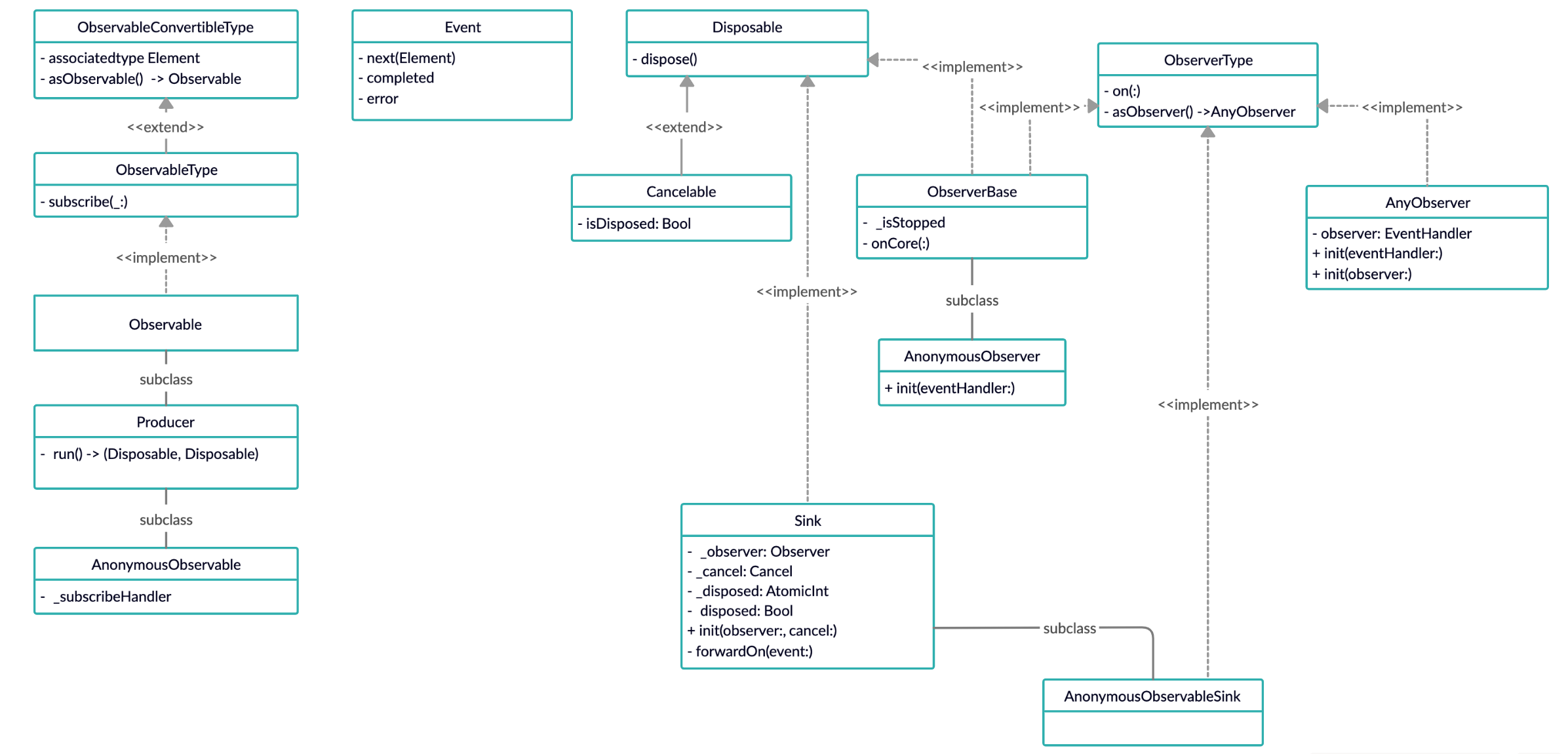
Finally, here’s a diagram I drew to summarize the relationships among the types discussed in this article:
Summary
At first glance, reading RxSwift’s source code really requires patience, because there’s a lot of abstraction. If you look only at the parts introduced in this article, it may feel over-engineered, but in fact these abstractions are designed to support other parts we haven’t covered yet. There are still many worthwhile things to learn from RxSwift:
- The design of
Disposableis a classic example of “program to an interface, not an implementation”. All related code is written againstDisposable, not any specificDisposabletype. - Each type has a very clear, single responsibility. For example,
Observable->ObservableType->ObservableConvertibleType: each protocol defines exactly one responsibility, and concrete implementations focus only on their own responsibility, minimizing concerns. AtomicIntis used elegantly to handle different concurrency scenarios.