Awaiting a Future
This is the last standalone post in my Programming Rust reading‑note series, and also the first post on this blog in 2022. As we say goodbye to 2021 and step into 2022, let’s talk about Asynchronous Rust.
At last year’s WWDC, Apple shipped Swift Concurrency with native async/await support. It’s fair to say that async has become a “must‑have” feature for modern programming languages. Today we’ll take a look at how Rust approaches this problem.
From Sync to Async
Synchronous Functions
Consider the following function:
use std::io::prelude::*;
use std::net;

fn cheapo_request(host: &str, port: u16, path: &str) -> std::io::Result<String> {
    let mut socket = net::TcpStream::connect((host, port))?;
    let request = format!("GET {} HTTP/1.1\r\nHost: {}\r\n\r\n", path, host);
    socket.write_all(request.as_bytes())?;
    socket.shutdown(net::Shutdown::Write)?;

    let mut response = String::new();
    socket.read_to_string(&mut response)?;
    Ok(response)
}
cheapo_request sends a very simple HTTP request over TCP. The diagram below shows its call stack over time from left to right:
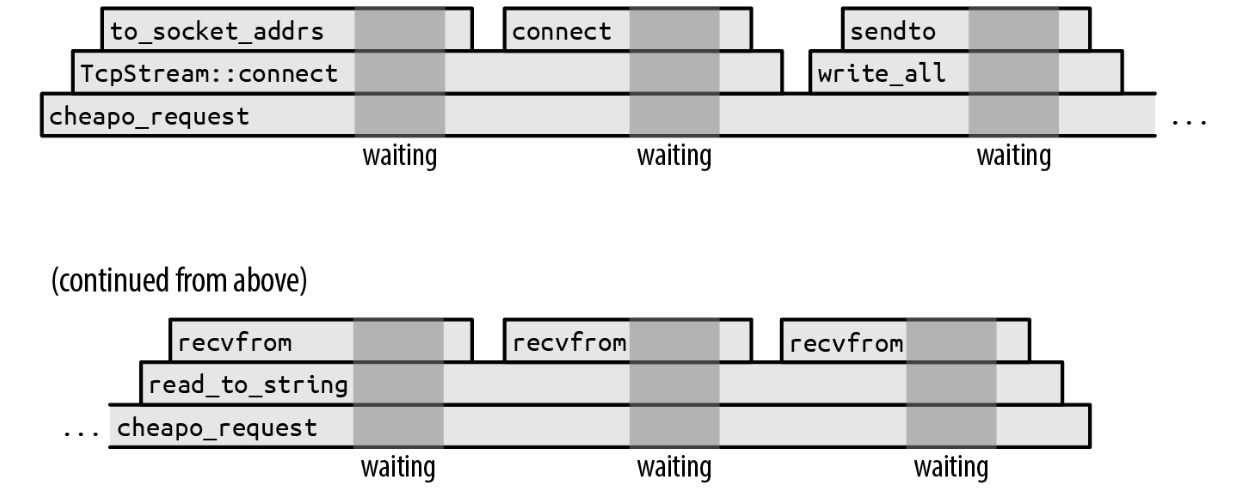
cheapo_request calls TcpStream::connect, write_all, and read_to_string in sequence. Those functions call other functions, which eventually reach system calls (the dark gray area in the diagram).
(The proportions in the diagram are not accurate. In reality, the dark gray part—the system calls—dominates the total runtime. The thread spends most of its time waiting on syscalls, doing nothing else.)
If we had a way to let the thread do other work while it’s blocked in a syscall, we could greatly improve performance. But achieving that isn’t trivial, because the function’s signature tells us it’s a synchronous function. We need an asynchronous version.
Future
Rust’s answer to async operations is the Future mentioned in this article’s title:
pub trait Future {
    type Output;
    fn poll(self: Pin<&mut Self>, cx: &mut Context<'_>) -> Poll<Self::Output>;
}

pub enum Poll<T> {
    Ready(T),
    Pending,
}
Future lives in the std::future module. It’s similar to a Promise: it represents a computation whose result you can check:
- If the computation has finished,
pollreturnsReadywith the final result. - If it’s not done yet,
pollreturnsPending.
Sharp‑eyed readers may have noticed that poll takes a Pin<&mut Self>. Pin is a new type we’ll discuss later; for now, you can mentally treat it as &mut Self.
At first glance, poll may ring some alarm bells:
- Is Rust’s async story really built on polling, which is often considered inefficient? Doesn’t that contradict Rust’s “high performance” marketing?
- What should we do when
pollreturnsPending? Do we just go do other work and come back andpollagain later? Does the program have to track which futures arePendingvsReady?
The good news is that using Future doesn’t necessarily make your code more complex, and in fact Future is a very nice example of a zero‑cost abstraction. How Rust pulls this off is what we’ll explore next.
Before that, let’s see roughly how futures are used. Take read_to_string from cheapo_request’s call stack as an example. Its synchronous signature is:
fn read_to_string(&mut self, buf: &mut String) -> std::io::Result<usize>;
The async version’s rough signature would look like:
fn read_to_string(&mut self, buf: &mut String) -> impl Future<Output = Result<usize>>;
The only difference is the return type: the async version returns a future that produces Result<usize>. Calling this async read_to_string just returns a type that implements Future. It does not actually start reading. The read only starts when that future is first polled.
(This is very similar to Rx’s Observable: a cold observable doesn’t do anything until you subscribe to it.)
Also note that we return impl Future rather than a concrete type. The concrete type is an internal compiler‑generated type that is not visible to callers. The only thing callers know is that it implements Future<Output = R>.
(For the details of how the compiler generates these types, I strongly recommend Philipp’s excellent article linked at the end of this post.)
async and await
Now let’s look at real async functions.
Using cheapo_request again, the async version might look like this:
use async_std::io::prelude::*;
use async_std::net;

async fn cheapo_request(host: &str, port: u16, path: &str) -> std::io::Result<String> {
    let mut socket = net::TcpStream::connect((host, port)).await?;
    let request = format!("GET {} HTTP/1.1\r\nHost: {}\r\n\r\n", path, host);

    socket.write_all(request.as_bytes()).await?;
    socket.shutdown(net::Shutdown::Write)?;

    let mut response = String::new();
    socket.read_to_string(&mut response).await?;
    Ok(response)
}
First, note the async before fn: that marks this as an async function. Even though the return type is written as Result, the compiler internally treats it as a Future. You can think of this as syntactic sugar.
Second, in the body we’re using async versions of write_all, read_to_string, etc. from the async_std crate. Each such call is followed by .await. Despite looking like a field access, await is actually a special Rust syntax that waits for the future to complete.
Unlike a normal function, an async function returns before executing its body. For example:
let response = cheapo_request(host, port, path);
Here, response is a Future. This future bundles up everything needed to run the function body: arguments, locals, etc. Its concrete type is compiler‑generated and opaque to callers, but we know it implements Future<Output = R>.
When we first poll the future response, execution starts at the beginning of cheapo_request and runs until the first await, where it polls the sub‑future returned by TcpStream::connect. If that sub‑future returns Ready, we get its value and continue; if it returns Pending, cheapo_request returns Pending too, and records where to resume next time it’s polled. In other words, repeated polls drive the function from one await to the next.
To do this, the future must record where to resume and any needed state. That’s what the compiler‑generated type stores.
This ability to “pause in the middle and resume later” is what distinguishes async functions from normal ones. It also implies that await can only be used inside async functions.
An important limitation today: only free functions and inherent methods can be async; trait methods cannot (yet) be async fn.
block_on
Now that we understand futures, how do we call async code from sync code and get a result?
async_std provides a block_on function. It takes a future as input and internally polls it until completion, then returns the result.
Example:
use async_std::task;

fn main() -> std::io::Result<()> {
    let response = task::block_on(cheapo_request("example.com", 80, "/"))?;
    println!("{}", response);
    Ok(())
}
block_on is a sync function that bridges from the async world back into the sync world.
The name is a warning: block_on blocks the current thread until the future completes. That means you must not call it inside async functions. In async code, you should await instead.
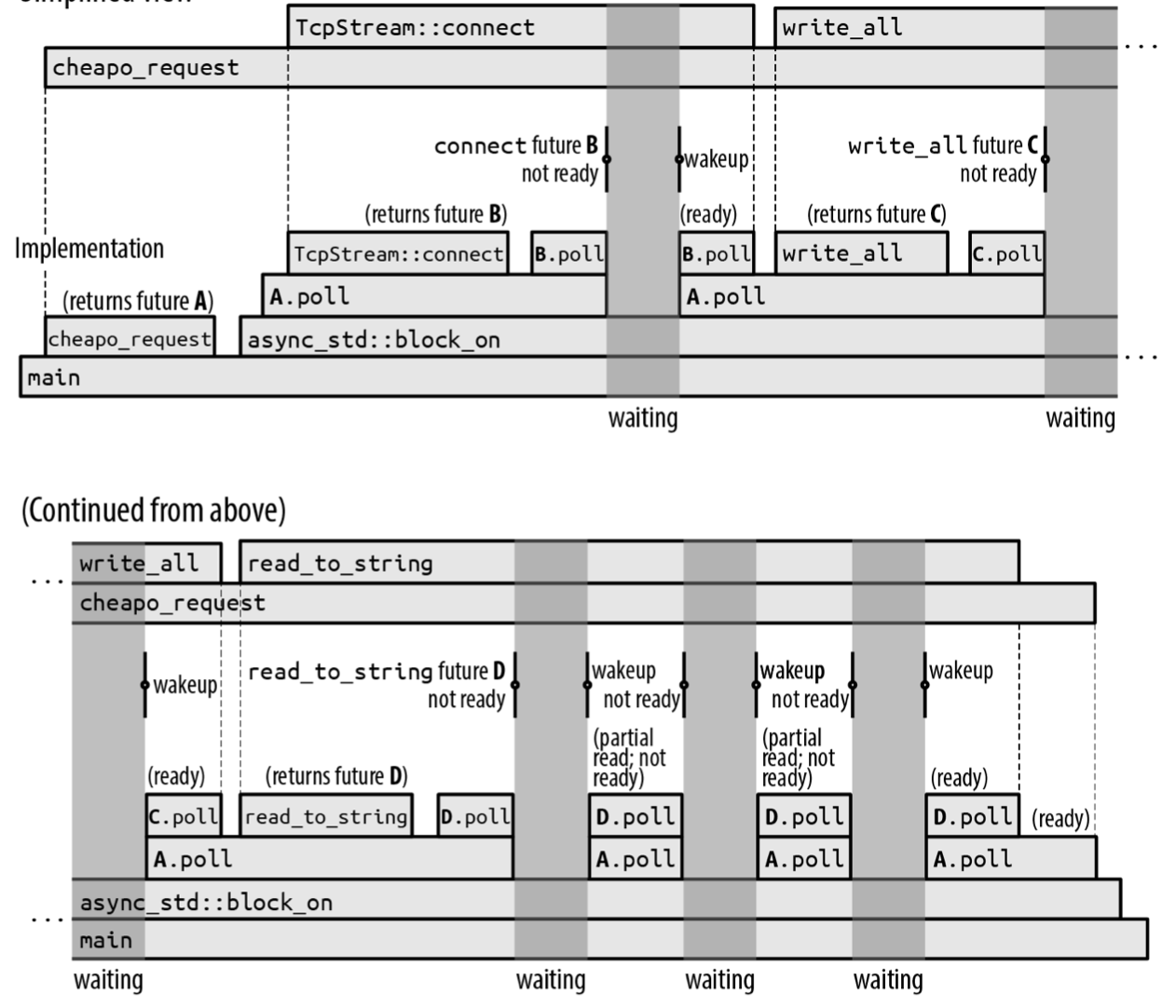
The diagram above shows how the async call stack looks:
maincallscheapo_request, getting future A, and passes A toblock_on.block_onpolls A, starting execution ofcheapo_request, which callsTcpStream::connectand gets future B.- At the first
await, A polls B. Because the network connection isn’t established yet,B.pollreturnsPendingand arranges to be polled again once the connection is ready. - Since B returned
Pending, A returnsPendingtoblock_on. block_onhas nothing else to do, so it puts the thread to sleep. The whole thread is blocked.- When B’s connection completes, it wakes
block_onso that it can poll A again. - Polling A resumes execution at the first
await, which polls B again. - This time, B returns
Ready(Ok(socket)). - The
TcpStream::connect(...).awaitexpression evaluates toOk(socket), andcheapo_requestcontinues, formatting the request and callingsocket.write_all. - Since
socket.write_allis also async, it returns a future C, and we repeat the sameawaitpattern. - … and so on.
A simple loop that repeatedly polls a future isn’t hard to write. The tricky part is knowing when to sleep and when to wake up, so you don’t waste CPU resources. That’s what block_on handles for us.
We’ll see how it does that shortly.
spawn
block_on blocks the current thread until the given future is Ready. If a single future monopolized an entire thread like that, async wouldn’t be very useful. The whole point is to allow a thread to do other work while some futures are waiting.
For that, we can use async_std::task::spawn_local (currently unstable). This function adds its future to a local task pool. When that future is Pending, subsequent calls to block_on will poll other futures from the pool. If you pass a bunch of futures to spawn_local and then call block_on on a final “join” future, that last future will coordinate polling of all the spawned tasks concurrently.
Conceptually, spawn_local is like an async version of std::thread::spawn:
spawntakes a closurecand starts a new thread to run it. It returns aJoinHandle, and callingjoinwaits for the thread to finish and returns the closure’s result.spawn_localtakes a futurefand adds it to a local pool. When you later callblock_onin that thread, it will poll futures from that pool. It returns anasync_std::task::JoinHandle, which is itself a future you can await to getf’s result.
An Example
Let’s make this concrete:
use async_std::task;

async fn many_requests(requests: Vec<(String, u16, String)>) -> Vec<std::io::Result<String>> {
    let mut handles = vec![];
    for (host, port, path) in requests {
        handles.push(task::spawn_local(cheapo_request(&host, port, &path)));
    }

    let mut results = vec![];
    for handle in handles {
        results.push(handle.await);
    }

    results
}
many_requests calls cheapo_request for each request and spawns them all via spawn_local. Then it awaits all of the returned JoinHandles.
This code doesn’t compile yet:
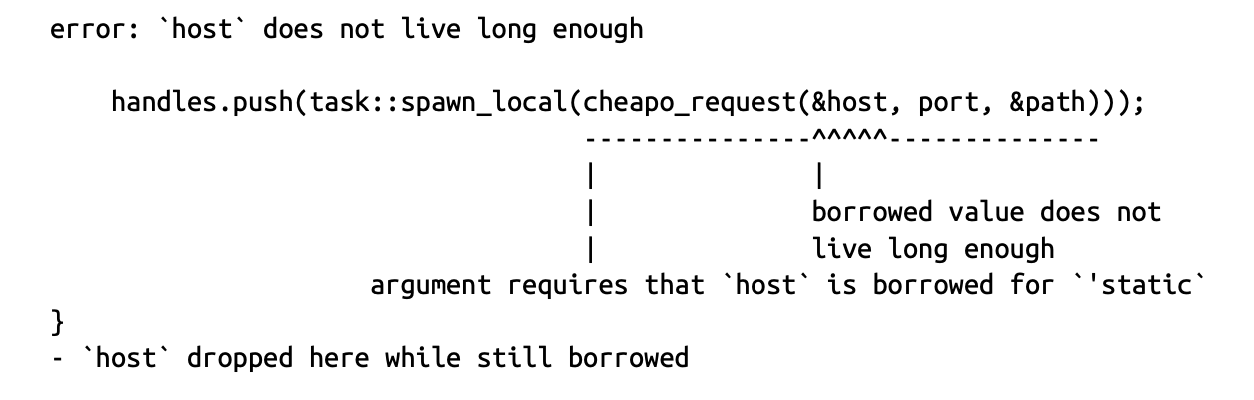
If we pass references into an async function, the returned future has to contain those references to have enough context to run. The future must not outlive the referenced values.
Here, spawn_local can’t guarantee that you’ll await the JoinHandle before dropping host and path. In fact, spawn_local accepts only 'static futures, because you might just never await the handle and let the task run until the program exits. This is similar to std::thread::spawn: if the closure captures references to local variables, the compiler will reject it.
One fix is to write an “owning” version of cheapo_request:
async fn cheapo_owning_request(host: String, port: u16, path: String) -> std::io::Result<String> {
    cheapo_request(&host, port, &path).await
}
Now the future owns host and path and they can safely be 'static. cheapo_owning_request simply awaits the original borrowed version, ensuring that host and path remain alive until the inner future completes.
We can then use block_on in main:
let requests = vec![
    ("example.com".to_string(), 80, "/".to_string()),
    ("www.red-bean.com".to_string(), 80, "/".to_string()),
    ("en.wikipedia.org".to_string(), 80, "/".to_string()),
];

let results = async_std::task::block_on(many_requests(requests));
for result in results {
    match result {
        Ok(response) => println!("{}", response),
        Err(err) => eprintln!("error: {}", err),
    }
}
This concurrently runs three requests; each can make progress while the others are waiting.
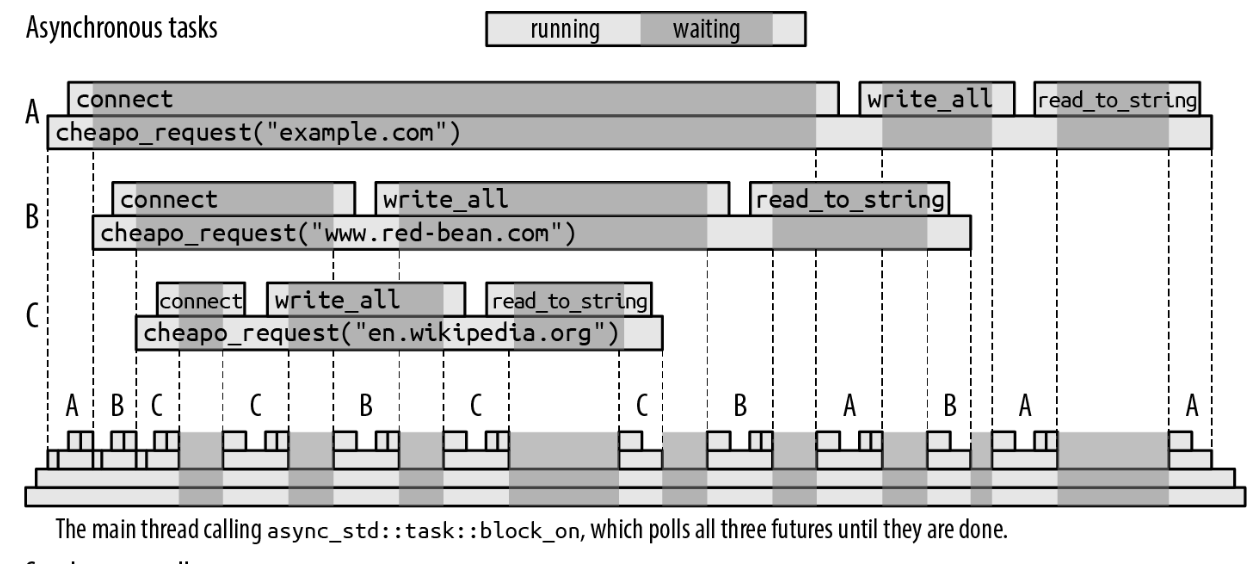
One possible execution:
many_requestsspawns tasks A, B, and C.block_onfirst polls A, which starts connecting toexample.com. When that returnsPending,block_onpolls B, then C.- Once A, B, and C have all returned
Pending,block_onsleeps. - Suppose Wikipedia responds fastest; C’s connect future completes first, waking
block_on. - When a task finishes, it stores its result in the
JoinHandleand returnsReady. - After all
cheapo_requestcalls finish (successfully or with error),many_requestsreturns,block_oncompletes, andmainprints the results.
All of this happens on a single thread, with A, B, and C interleaving execution in small chunks.
The key difference between async tasks and threads is when context switches occur. Async tasks switch only when an awaited future returns Pending. That means if a task does a long CPU‑bound computation without await, other tasks are starved. Threads, on the other hand, can be preempted by the OS at any time, ensuring fair CPU sharing.
So async performance depends on how cooperative your futures are in sharing the thread. If you need long‑running compute, we’ll see later how to handle that.
Async Closures
Instead of async fn, you can also use async closures to build async functions:
use std::io;
use std::future::Future;

fn cheapo_request<'a>(
    host: &'a str,
    port: u16,
    path: &'a str,
) -> impl Future<Output = io::Result<String>> + 'a {
    async move {
        // function body here
    }
}
Calling this returns a future representing the closure’s result. Aside from not using async fn, the signature is equivalent.
Thread Pool
So far we’ve mostly looked at I/O‑bound tasks, but many real workloads are CPU‑bound. When one thread isn’t enough, you can move futures to a thread pool using async_std::task::spawn.
spawn is more common than spawn_local because you nearly always want to use all available cores.
Its usage is similar:
use async_std::task;

let mut handles = vec![];
for (host, port, path) in requests {
    handles.push(task::spawn(async move {
        cheapo_request(&host, port, &path).await
    }));
}

// await handles...
spawn also returns a JoinHandle future, but it’s polled by the thread pool itself as long as there are idle threads.
An important detail: to avoid idle threads, the runtime tries to poll a future as soon as it becomes ready again. That means a task might start on one thread, hit an await, and then resume on a different thread. From the async function’s perspective everything looks linear, but under the hood its state might bounce between threads.
This implies that any state used by an async function must be thread‑safe.
Also, because spawn moves the future to another thread, that future must be Send. In other words, all arguments, locals, etc. captured in the future must be Send. This is the same as for std::thread: its closure runs in another thread.
It’s easy to trip over this, for example:
use async_std::task;
use std::rc::Rc;

async fn reluctant() -> String {
    let string = Rc::new("ref-counted string".to_string());
    some_asynchronous_thing().await;
    format!("Your splendid string: {}", string)
}

task::spawn(reluctant());
This fails to compile:
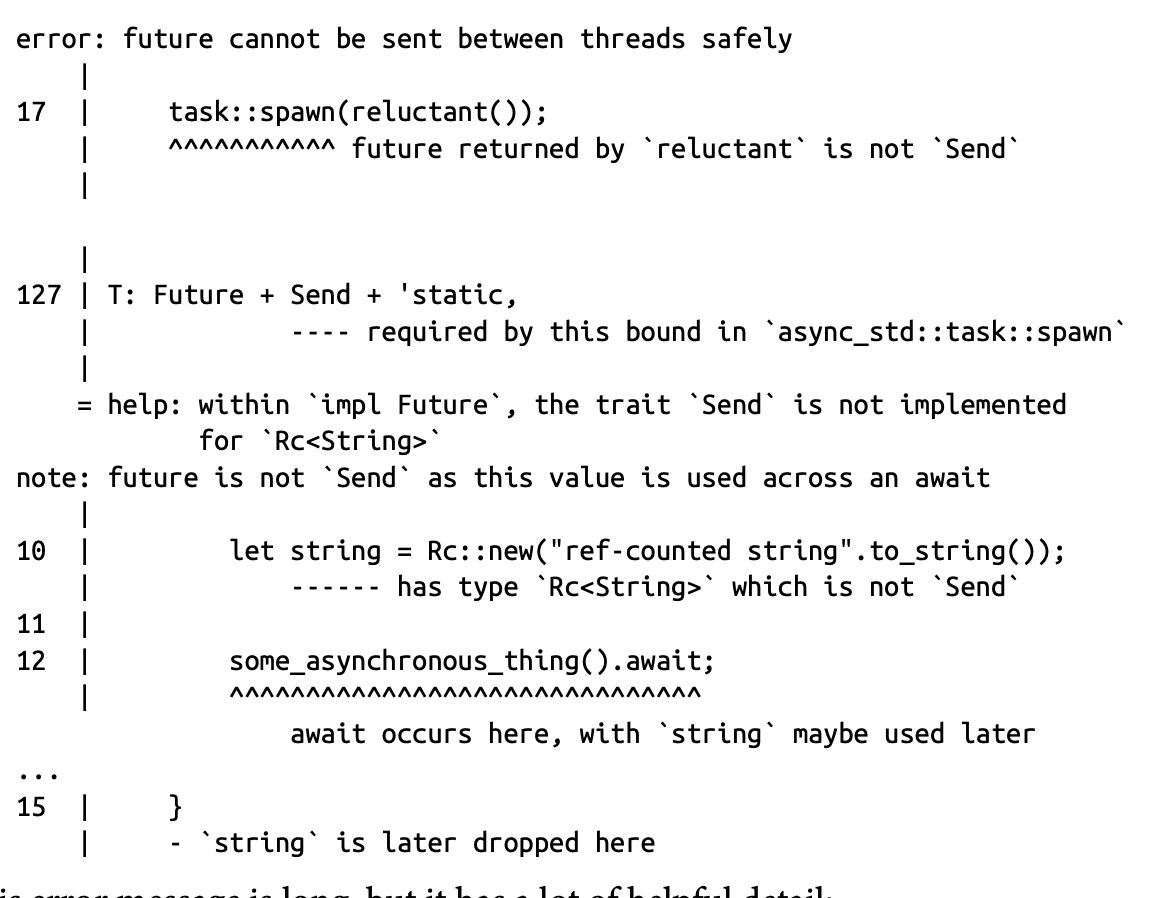
The future generated by reluctant needs to hold an Rc<String> so that string remains available after the await. But Rc is not Send, so the future cannot be Send, and thus cannot be passed to spawn.
Two ways to fix this:
- Use
Arcinstead ofRc. -
Restrict the scope of the non‑
Sendvalue so that it’s dropped before anyawait:async fn reluctant() -> String { let return_value = { let string = Rc::new("ref-counted string".to_string()); format!("Your splendid string: {}", string) // Rc<String> is dropped here... }; // ... so it doesn’t exist when we suspend here. some_asynchronous_thing().await; return_value }
Expensive Computation
A well‑behaved future should return from poll quickly, so that other tasks get a chance to run. If a future does heavy computation inside poll, other tasks may starve.
async_std offers a yield_now helper:
while computation_not_done() {
    // do one medium-sized step of computation...
    async_std::task::yield_now().await;
}
The first time the yield_now future is polled it returns Pending and yields the thread to other tasks. The second time it returns Ready, and your async function resumes.
yield_now isn’t always sufficient. If the computation lives inside a third‑party library, you can’t sprinkle yield_now calls inside its inner loops.
In those cases, use spawn_blocking. It takes a closure and runs it in a dedicated blocking thread, returning a future whose output is the closure’s return value. Because the work moves to another thread, it doesn’t starve the async runtime.
Comparing Async Designs
Rust’s async model resembles other languages in many ways. JavaScript, C#, and Rust all have await and a concept of an “incomplete computation”: JS has Promise, C# has Task, Rust has Future.
Where Rust differs is in its polling model. In JS and C#, async functions start running as soon as they’re called, and the language runtime provides a built‑in global event loop that resumes them after await.
In Rust, calling an async function just creates a Future. It doesn’t run until you give it to an executor like block_on to be polled. Executors play the role of event loops in other languages—but because Rust lets you choose the executor, the standard library doesn’t need a global one.
Futures and Executors
We’ve said that while futures use polling, executors only poll “at the right time”. We still haven’t answered the key question, which is probably on your mind:
How does the executor know when the right time is?
Consider this code:
task::block_on(async {
    let socket = net::TcpStream::connect(address).await?;
    // ...
})
When block_on first polls this future, the TCP connection almost certainly isn’t ready, so block_on must go to sleep. But how does it know when to wake up and poll again? When the network connection finishes, TcpStream needs some way to tell block_on that the future is ready to make progress.
When an executor polls a future, it passes in a callback known as a waker. If the future isn’t ready yet, the Future trait requires implementations to:
- Return
Pending. - Arrange to call the waker later when it’s worth polling again.
A skeletal implementation:
use std::task::Waker;

struct MyPrimitiveFuture {
    // ...
    waker: Option<Waker>,
}

impl Future for MyPrimitiveFuture {
    type Output = ...;

    fn poll(mut self: Pin<&mut Self>, cx: &mut Context<'_>) -> Poll<...> {
        // ...

        if /* future is ready */ {
            return Poll::Ready(final_value);
        }

        // Save the waker for later.
        self.waker = Some(cx.waker().clone());
        Poll::Pending
    }
}
When the future is ready again, it wakes the executor:
if let Some(waker) = self.waker.take() {
    waker.wake();
}
Ideally, futures and executors alternate between polling and waking: the executor polls and sleeps, then the future calls the waker, then the executor wakes and polls again.
Async functions and closures themselves don’t handle wakers; they just pass the Context they receive on to inner futures, delegating waker storage and waking to them.
Executors are allowed to poll a future more often than strictly necessary; that’s harmless but inefficient. Wakers, however, must not be called unless polling really might return Ready, otherwise you waste work.
Implementing spawn_blocking
Earlier we mentioned spawn_blocking, which runs a blocking closure on a separate thread and returns a future of its result. Now that we understand wakers, we can implement it ourselves.
The signature:
pub fn spawn_blocking<T, F>(closure: F) -> SpawnBlocking<T>
where
    F: FnOnce() -> T,
    F: Send + 'static,
    T: Send + 'static,
Because the closure runs on another thread and its result is sent back, both F and T must be Send and 'static.
SpawnBlocking looks like this:
use std::sync::{Arc, Mutex};
use std::task::Waker;
use std::future::Future;
use std::pin::Pin;
use std::task::{Context, Poll};

pub struct SpawnBlocking<T>(Arc<Mutex<Shared<T>>>);

struct Shared<T> {
    value: Option<T>,
    waker: Option<Waker>,
}

impl<T: Send> Future for SpawnBlocking<T> {
    type Output = T;

    fn poll(self: Pin<&mut Self>, cx: &mut Context<'_>) -> Poll<T> {
        let mut guard = self.0.lock().unwrap();

        if let Some(value) = guard.value.take() {
            return Poll::Ready(value);
        }
        guard.waker = Some(cx.waker().clone());
        Poll::Pending
    }
}
Shared is the rendezvous point between the future and the worker thread, so we wrap it in Mutex + Arc. When the future is polled, it first checks whether a value is available. If so, it takes ownership and returns Ready. Otherwise, it stores the waker and returns Pending.
spawn_blocking then spins up the worker thread:
pub fn spawn_blocking<T, F>(closure: F) -> SpawnBlocking<T>
where
    F: FnOnce() -> T,
    F: Send + 'static,
    T: Send + 'static,
{
    let inner = Arc::new(Mutex::new(Shared {
        value: None,
        waker: None,
    }));

    std::thread::spawn({
        let inner = inner.clone();
        move || {
            let value = closure();

            let maybe_waker = {
                let mut guard = inner.lock().unwrap();
                guard.value = Some(value);
                guard.waker.take()
            };

            if let Some(waker) = maybe_waker {
                waker.wake();
            }
        }
    });

    SpawnBlocking(inner)
}
The spawned thread runs the closure, stores its result in Shared, takes the waker (if any), and wakes it.
Pinning
When we first introduced Future, we hand‑waved past the Pin argument. Now let’s circle back. “Pin” here literally means “to pin down”, so what is Rust trying to pin?
Before answering, recall one of the first concepts we learn in Rust: moves.
Take a simple string example:
fn main() {
    let mut s1 = String::from("Hello");
    let s2 = s1;
}
On line 3, s1 is moved into s2. Conceptually, the compiler allocates stack space for s2, copies the stack representation of s1 into s2, and invalidates s1. A move is essentially a change in address.
Moves are fundamental in Rust, but they can cause trouble for a certain pattern: self‑referential structs.
Self‑Referential Structs
A self‑referential struct is one where a field references another field (or the struct itself). For example (schematically):
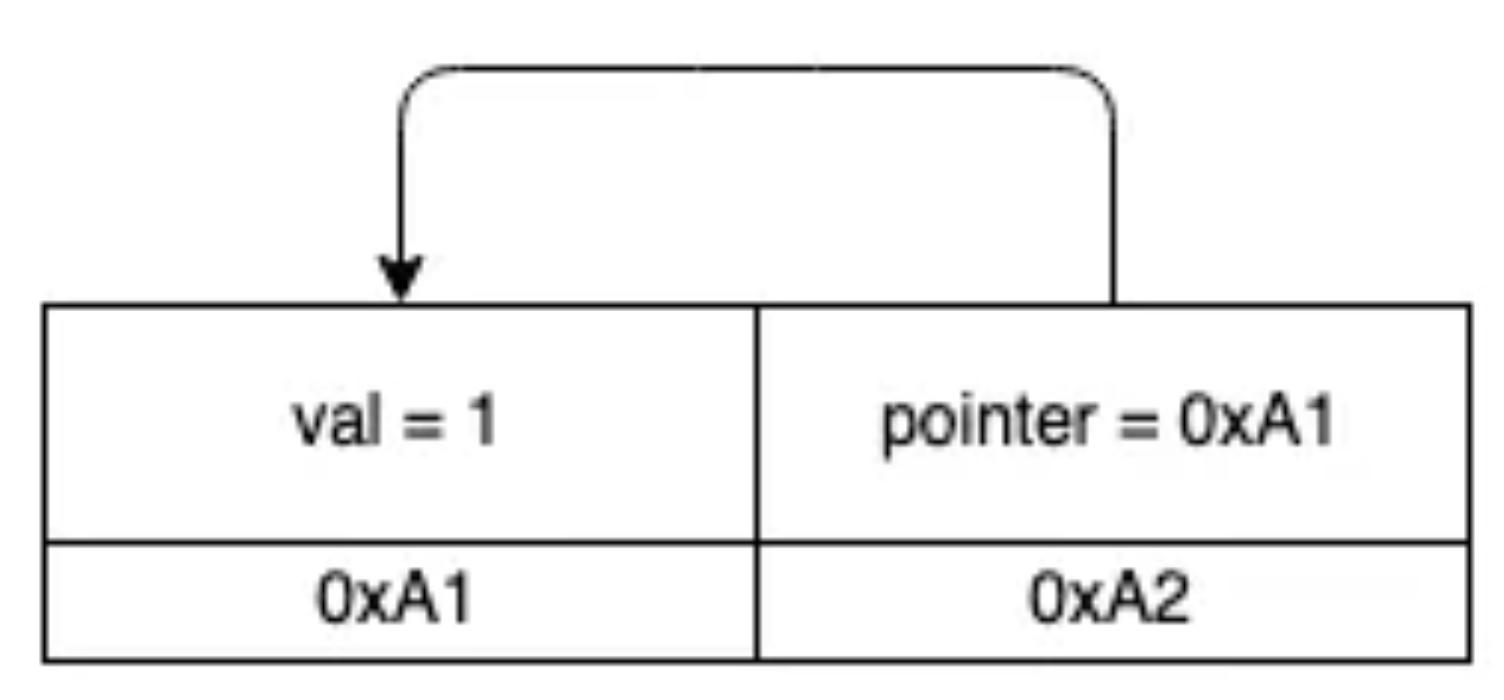
Here pointer points into the object itself. This is fine… until the struct is moved. After a move, you might end up with:
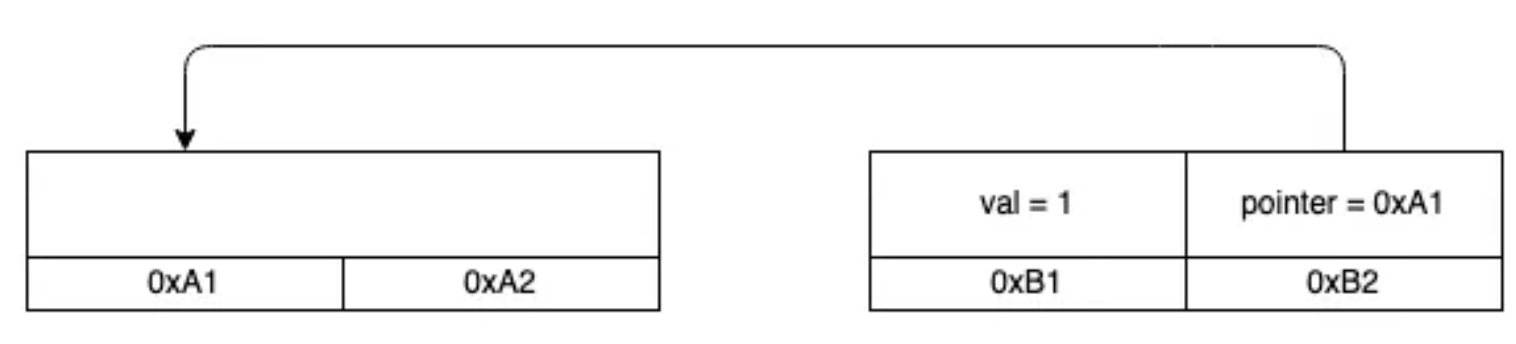
We moved the value, but the internal pointer still points to the old location, which is now invalid. That’s a recipe for undefined behavior—exactly what Rust is trying to prevent.
And as it happens, compiler‑generated futures are very likely to be self‑referential. They need to store state that may include references into themselves.
Rust solves this with the Pin smart pointer. A Pin<T> promises that the value will never be moved again. For pinned types, the compiler enforces that behavior.
How does the compiler know which types can be moved and which can’t? Via the Unpin marker trait:
- Types that implement
Unpincan still be moved. The compiler automatically implementsUnpinfor almost all types where moving is safe, such as integers, booleans, etc. - Types that do not implement
Unpin(often written as!Unpin) are “pinned” once placed behindPin<T>.
Unpin is a bit unintuitive at first because of the negation in the name.
This post only scratches the surface of Pin. For a deeper dive, see Philipp’s article and Folyd’s two posts in the references section.
When Async Helps
Writing async code is trickier than writing threaded code. You need the right async I/O primitives, the right runtime, and sometimes to worry about details like pinning that you can safely ignore with plain threads.
So what’s the point? Why bother with async at all?
One common claim is that “async is better for I/O”. That’s not quite right. If your program spends most of its time waiting on I/O, rewriting it to be async won’t magically make it faster. Under the hood, both sync and async I/O use the same OS primitives. In fact, async often incurs an extra syscall: one to initiate and another to check readiness.
Another claim is that async is easier than threads. In JavaScript or Python, this can be true: you can get concurrency without worrying about locks, because there’s only one thread actually running code. In Rust, though, if your code compiles, there are no data races, and you have high‑level tools (Mutex, channels, atomics, etc.) to manage shared state. Async doesn’t buy you special safety advantages there.
So what are the real benefits of async in Rust?
- Lower per‑task memory usage. On Linux, a thread typically reserves at least ~20 KB of stack. A future, by contrast, is often much smaller, and the compiler will keep shrinking it as optimizations improve.
- Cheaper task creation. Creating a thread on Linux can cost around 15 µs; creating an async task can be as cheap as 300 ns—roughly fifty times faster.
- Faster context switching between tasks. In ideal cases, switching between tasks can be ~0.2 µs versus ~1.7 µs per thread context switch.
These advantages matter in scenarios like high‑load servers: each async task costs less memory and CPU, so you can handle more concurrent connections.
Summary
In this post, we started from the Future abstraction and, using async_std as our runtime, walked through the core concepts and patterns in Rust’s async story.
Rust’s async ecosystem is the product of cooperation between:
- The language, which provides syntax like
asyncandawait. - The standard library, which defines the core traits and types:
Future,Context,Pin,Waker, etc. Because the compiler needs these definitions to compile async functions, they must live instd. - Third‑party crates like
async-std(andtokio), which provide concrete runtimes and executors. Not every program needs them, which is why they live outside the standard library.
Rust’s async model is also a nice demonstration of zero‑cost abstractions: it offers a clean, high‑level way to write async code while staying very close to the metal in terms of performance.
Even if you don’t need async today, it’s a powerful tool to keep in your toolbox. Whether you choose threads or async for a given problem, you’ll still end up profiling and tuning hotspots—there are no silver bullets.